
Environmental Philosopher & Public Health Scientist
Mobilizing 21th century frameworks of ecology and planetary health for research, teaching, consulting, and human transformation.
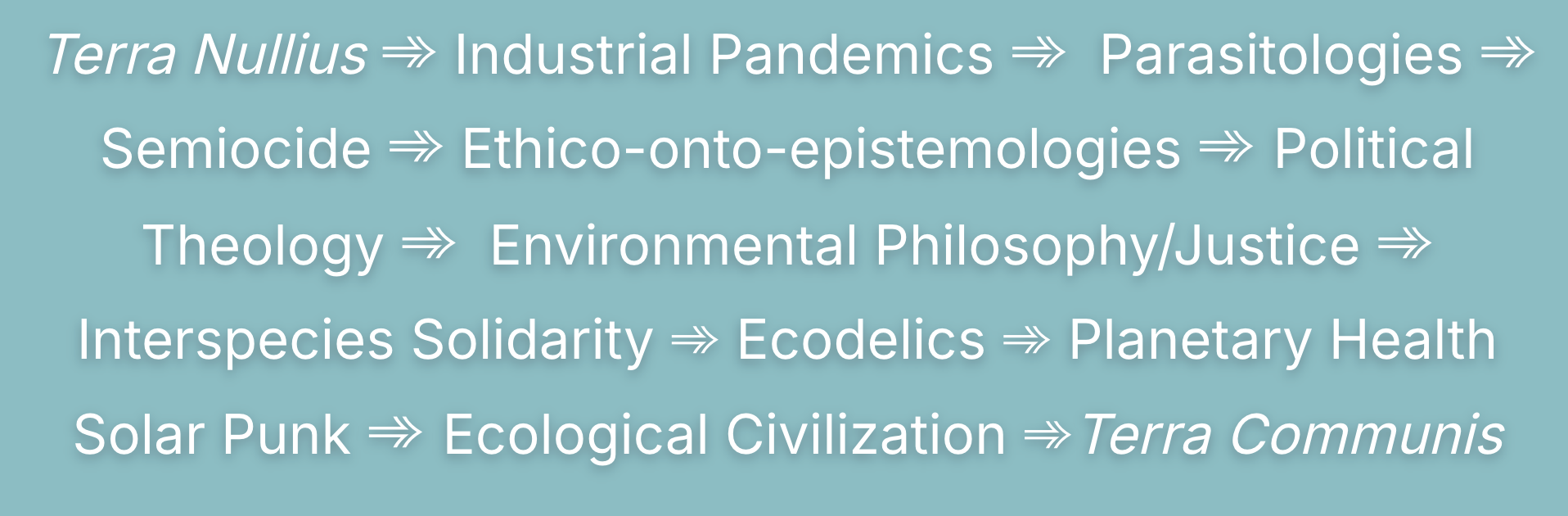

Mission Statement
As our societies realize the necessity to reprioritize ecology and biology as master sciences in the great transition upon us, I see science, public health, and philosophy working synergistically, just as medicine now accepts a biopsychosocial model of health. Writ large, this looks like: (1) understanding how life and ecosystems flourish, in order to (2) allow us to figure out how to calibrate our values to meet those non-negotiable fundamentals, so that we can (3) design our societies to meet the needs of all, enabling greater ingenuity, innovation, and empowerment.
Each one of us contributes our own crucial piece of the puzzle in addressing our metacrisis, and I honor each sincere contribution. In my research, education and service efforts, I endeavor to prioritize issues which have the most potential impact to address major societal challenges upstream. My interventions include providing deeper insight into hyped topics, supporting high-level pivots to emergent paradigms in policy or business, metaorganizing the various good-hearted but disorganized single-issue organizations to align and work to make common cause, or precision pushing back against misguided enthusiasm for deus ex machina solutions that are single metric, not effective, or will make things worse.
To accomplish these different modes of recursive research, applied scholarship, mentorship and consulting, I perform experiments, reflect on the history of culture and concepts, and piece together documentary evidence from the archives of the Anthropocene to inform and assess policy, applying systems thinking to bio-ethical cases. These engaged methodologies map multi-level patterns in the social and environmental determinants of health together with philosophical concerns about the utility of our utilities, aiming to provide direction for targeted interventions leveraging ethically- and science-based social and institutional harmonization.
I am lucky enough to have my work funded by multiple active grants on both sides of the Atlantic, large and small, public and private (see Research).
Current Roles
Principal, Feral Ecologies Lab
Assistant Professor, Dynamics of Inclusive Prosperity Initiative, Erasmus School of Philosophy, Erasmus University Rotterdam
Full Member, The Center to End Corporate Harm, University of California, San Francisco
Advisor, Luminous Biomedical Sciences Consulting
Editor-in-Chief, Biosemiotics

Yogi is principal of Feral Ecologies Lab, a think and action-tank bringing complexity into policy to achieve sustainability.
Ph.D. in Environmental Philosophy
magna cum laude
University of Kiel, Germany
Postdoctoral research at the University of California at San Francisco in public health policy & the University of Vienna in plant ethics
Graduate degrees from the London School of Economics & UCLA in political science
Predoctoral Research at UCSF at the Center for Tobacco Control Research and Education
Bachelors degrees (Rhetoric and Political Science, w/honors) from the University of California at Berkeley
Recent Posts
“I don’t write like ChatGPT, ChatGPT writes like me” – positional competition, multipolar traps, and nested semiotic traps
"I don't write like ChatGPT, ChatGPT writes like me" This erudite Kenyan's tour de force of the gatekeeping of of the category human, against colonized people, and how they sought to speak in the master's language to be considered human, and then their achievement of...
Emotion Milking. the case study of Ludovico Einaudi
Emotion Milking The pseudo-classical music artist Ludovico Einaudi has mastered the art, long before AI, of milking our emotions without having any real substance. Perhaps, as a Hollywood movie composer, it is no wonder that Einaudi's style evokes what classical music...
Legal Symposium 2026 presentation
Tomorrow I'll be giving a talk, Ecocide as Semiocide, for the International Association of Conference Interpreters, in The Hague. Here's the abstract: When we speak of ecocide, to what loss are we referring? Biodiversity? Habitat for a collection of species that have...