
I recently came across this explainer on LinkedIn which imagines that we can still succeed by bringing more data points into the wrong category. This is the classic data vs capta move of epistemological arrogance, or what is better known as agnotology.
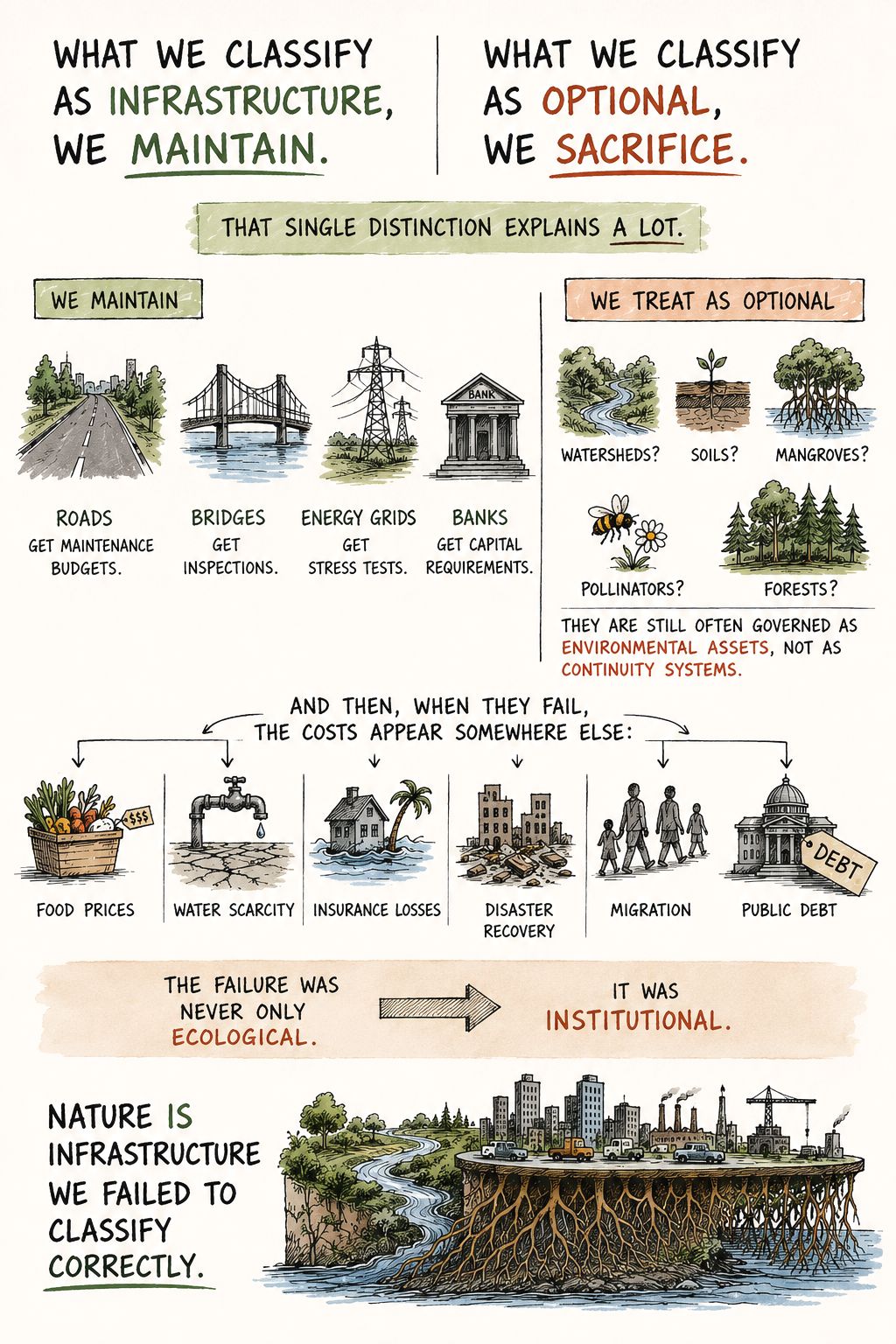
It’s not that I disagree with the premise of the figure, that we need to pay attention that which has been excluded. But the fact is that we can never totally account for everything that matters. Just as the concept Werner Heisenberg introduced us to more than a century ago, based on the insights from Niels Bohr, we cannot know the system totally from which we have sprung. The delusion of control is that we can totally understand our society, our biosphere, or any other complex system which is connected to others. Connected to this epistemic humility is the notion of Prat?tyasamutp?da, or interdependent co-arising. This challenges our static ontologies. If things are changing as everything else changes, then there is no permanent thing which we can measure time and again and come back to against different contexts. Which means that while physics and chemistry seem relatively stable compared to biology and culture, even those wobble, oscillating across time and space.
This post further tries to categorize and make progress based on inherently nebulous categories. The philosophy of science move (or, at lease mine), is that we cannot use the quantitative approach to assess and deal with qualia (qualitative ‘data’), precisely because truly qualitative data — that is, how the world works — will always exceed our data points, measurement tools, or comprehension of what factors are actually contributing to the phenomenon we are interested in controlling.
Nature isn’t ‘infrastructure’ because we cannot correctly classify any particular ‘part’ as essential or irrelevant. At least not reliably, or to any clever end. When we build anything, we make choices regarding salience. We decide what is worth paying attention to and what can be a concession to ignore. This choice is part of having symbolic culture, which allows for a rift between denotative and connotative meaning. Just like Marx’s metabolic rift (unearthed and elaborated by sociologist John Bellamy Foster), where societies broke their sustainability with the earth and started colonizing the rest of civilizations to steal their resources in order to deal with their patent disregard for ecological metabolic limits. Instead of being aware of the folly of exceeding ecological limits, colonizers in their moment of becoming colonizers double down. They increase their delusion that using resources beyond their territories will allow them to keep up unsustainable practices, which before long become so identified with, that they begin to defend such illogics as ‘culture’ and ‘way of life’. Said people will then defend their unsustainable way of life against anyone who tries to ring the alarm, or stop their cannibalistic practices.
The metabolic rift has its parallel in the epistemological rift, where we become overconfident that we can figure it out. This is where agnotology comes in; attention is always selective, and the conceit is that we can ever finally figure out what is salient, and what is not. This is where the deep work of John Vervaeke, enactivism, and the notion of ‘relevance realization’ is a necessary adjunct to being able to make sense of how to select for the most important aspect without the strain, tension, or compulsion of decision fatigue, FOMO, or self-doubt that comes with efforting. But we cannot simply add more data points to a moldy, incomplete schema which is impossibly incomplete. This is why Johanna Drucker emphatically made the distinction between between data (which is given) and capta, which is taken. Our data is not given. As Descartes and Bacon showed us so clearly, it is taken (in their version, raped from the earth). So, what we take is contingent on the adaequatio of Schumacher in A Guide for the Perplexed, describing Aquinas’ “adaequatio rei et intellectus — the understanding of the knower must be adequate to the thing to be known.” Schumacher writes:
For every one of us only those facts and phenomena “exist” for which we posses adaequatio, and as we are not entitled to assume that we are necessarily adequate to everything, at all times, and in whatever condition we may find ourselves, so we are not entitled to insist that something inaccessible to us has no existence at all and is nothing but a phantom of other people’s imaginations.
The problem is not the squirrelliness of the scintillating universe, but the constancy and depth of the perceiver. “When the level of the knower is not adequate to the level (or grade of significance) of the object of knowledge, the result is not factual error but something much more serious: an inadequate and impoverished view of reality,” Schumacher writes.
Because nature is not a monolith, we can never fully account for it. Because causation, agency, and semiosis (according to C.S. Peirce), are always redundant, diverse, and with lots of buffer room against perturbation, the resilience of reality means that we can never pin down all of the circuitry of reality. This is like the hard problem of consciousness. The hard problem of causation is that the more we try to ignore and strip out everything but that which we have identified as the mechanisms of action, the more the backlog of brittleness builds up and shatters our modes and methods of accessing reality according to our previously overconfident underdetermined models.
Some of the perpetrators of reification, of the type of thinking that makes the authority and the power of colonizing logic into this sacrosanct forgone conclusion, are the worst revolutionaries. Those who swear they are most fighting against the horrible stuff of colonialism in all its forms take it to be more substantial than it is. Criti-hype means that our sensationalism of AI, of how much power the fossil fuel companies have, how far removed politicians are from ordinary people, how immune structures of power and violence are from accountability, actually do the work of their worst enemy. They take the hype at face value and spread the meme. The are superspreaders of a belief and ideology they hate vehemently and fear so much that they are overtaken by it, fighting it, but spreading the reality of the presumption nonetheless.
There are other options. There is the idea that by playing with inherently unquantifiable concepts, that we can push past our need for optimization, which stems from insecurity and a will-to-control. As Jesús Martín González writes, “Maintenance has a double bind. It’s the first human need and the second process. As a need and process, it keeps the vital hand that feeds us.” He provides an infographic that explains some of these paradoxes.
