
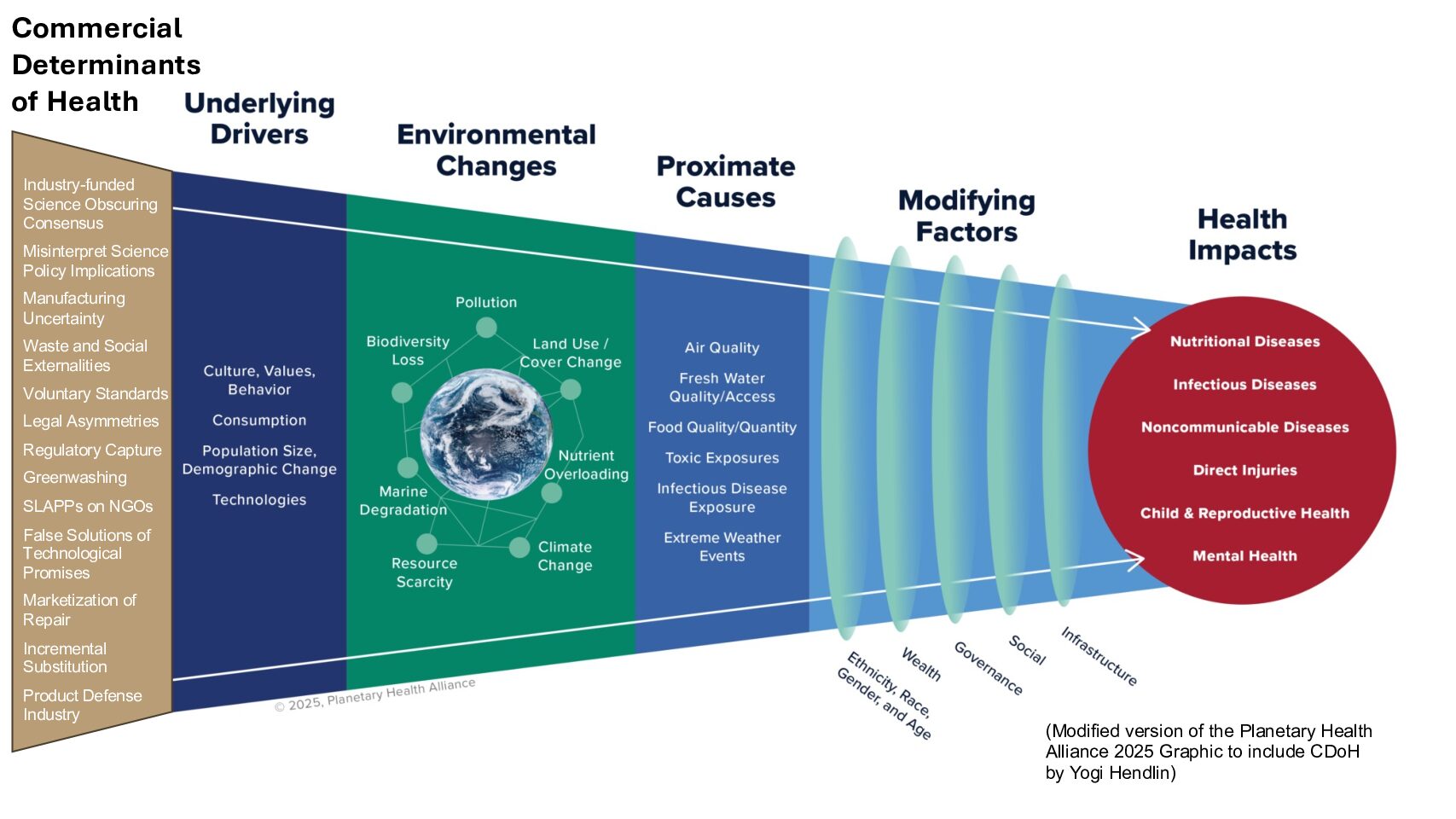
Through these mechanisms, commercial power reshapes the underlying drivers of planetary harm—normalizing overconsumption, embedding fossil- and chemical-dependent technologies, and constraining governance to market-compatible solutions. The result is a cascade of environmental changes: climate destabilization, biodiversity collapse, land-use conversion, marine degradation, nutrient overload, pollution, and growing resource scarcity. These are not isolated crises but system-level outcomes of an economic model defended through policy influence, media narratives, and the strategic reframing of ecological limits as technical challenges rather than political choices.
Downstream, these environmental disruptions translate into worsening air and water quality, toxic exposures, food insecurity, infectious disease risk, and increasingly extreme weather—harms that are then filtered through unequal social conditions of wealth, infrastructure, and governance. What appears as a planetary health crisis is therefore also a crisis of power: whose knowledge counts, whose interests are protected, and whose bodies and ecologies become sacrifice zones. Seen this way, the commercial determinants of health are not merely contributors to planetary ill-health; they are the connective tissue linking corporate influence to boundary transgressions and to the growing burden of nutritional, infectious, chronic, reproductive, and mental health harms worldwide.