
Democracy is not “under threat.” It is being abandoned.
The U.S. is sliding toward dictatorship.
Europe is following closely behind.
Much of the “liberal West” is choosing appeasement over resistance.
This is not a sudden crisis. It is the predictable outcome of a political system that refuses to confront its own ecological and economic foundations.
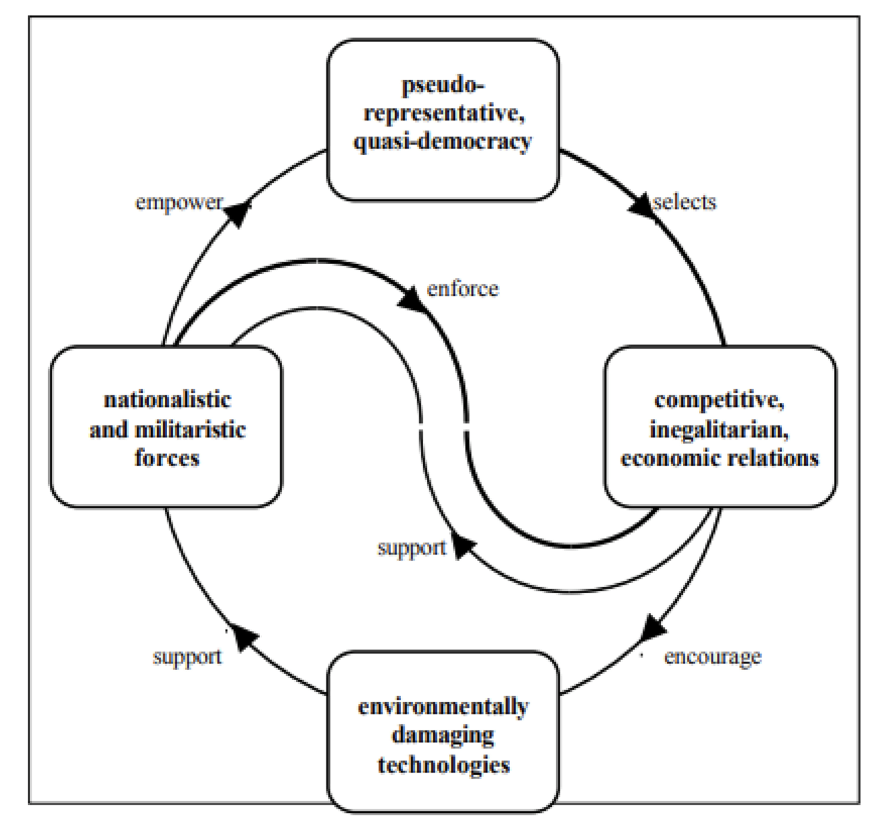
In Some Theoretical Foundations for Radical Green Politics (2004), Andrew Carter made this clear twenty years ago:
Liberal environmentalism cannot stop authoritarianism.
Market-based “green growth” cannot coexist with democracy under ecological limits.
When systems built on endless extraction hit planetary boundaries, they turn to coercion.
Carter’s 2004 intervention was written against the backdrop of neoliberal consolidation and ecological crisis, yet its conceptual architecture anticipates the current conjuncture with notable precision. The paper’s core claim, that ecological politics must be radical, structural, and systemic, rather than reformist or technocratic, maps directly onto the present failure of liberal democracies to resist authoritarian capture.
From a this perspective, the present slide toward dictatorship is not an aberration but an endogenous outcome of political-economic systems that prioritize growth, hierarchy, and instrumental rationality over ecological limits, social equality, and democratic depth.
Authoritarianism as an Ecological–Political Pathology
Carter identifies ecological destruction and social domination as co-produced phenomena. Radical green politics rejects the liberal assumption that environmental degradation can be addressed within existing institutional frameworks.
Applied to the present:
-
Authoritarianism emerges as a stabilization strategy for ecologically and economically unsustainable systems.
-
As ecological limits intensify (climate instability, resource scarcity, infrastructural fragility), elites increasingly abandon democratic mediation in favor of coercive control.
-
Fascist politics function as an extractive governance mode, designed to suppress dissent while maintaining growth-oriented accumulation.
The current authoritarian turn in the U.S. and Europe thus reflects not merely ideological extremism, but a structural response to systemic ecological contradiction.
Appeasement as Liberal Ecologism’s Failure Mode
Carter sharply distinguishes radical green politics from liberal environmentalism, criticizing the latter for its commitment to:
-
Incremental reform
-
Market-based solutions
-
Institutional accommodation
This distinction is directly applicable to contemporary appeasement of fascism:
-
Liberal states prioritize stability, markets, and geopolitical alignment over democratic resistance.
-
Environmental policy is subordinated to “competitiveness,” “energy security,” and “national interest.”
-
Authoritarian actors are normalized so long as they preserve economic throughput.
From Carter’s framework, appeasement is not a moral failure alone but a structural incapacity: liberalism lacks the conceptual resources to oppose fascism because both share commitments to hierarchy, growth, and instrumental reason.
Radical Green Politics as Anti-Fascist Politics
Carter argues that radical green politics is necessarily oppositional, rejecting the legitimacy of institutions that reproduce domination. When applied to the present authoritarian drift, this implies:
-
Anti-fascism cannot be separated from ecological politics.
-
Resistance must target systemic drivers (capital accumulation, militarism, extractivism), not only authoritarian personalities or parties.
-
Democratic renewal requires material reorganization, not rhetorical defense of “values.”
In this sense, radical green politics reframes anti-fascism as a biopolitical and ecological struggle, not merely a constitutional one.
Decentralization Against Dictatorship
A central Carterian principle is decentralization—not as administrative reform, but as a redistribution of power away from centralized, technocratic, and coercive systems.
Applied today:
-
Authoritarianism thrives on centralized control of energy, food, data, and security.
-
Radical green politics undermines dictatorship by promoting:
-
Local autonomy
-
Commons-based resource governance
-
Cooperative and mutualist institutions
-
-
Such structures reduce the leverage of authoritarian states by making populations less dependent on centralized infrastructures.
Decentralization here functions as preventive anti-authoritarianism.
Repoliticizing Ecology Against Fascist Mythologies
Carter emphasizes the need to repoliticize ecological questions, rejecting both technocratic management and reactionary “blood and soil” narratives.
In the current moment:
-
Fascist movements increasingly appropriate ecological language (national nature, borders-as-ecology, demographic panic).
-
Liberal responses depoliticize ecology, framing it as technical risk management.
-
Radical green politics alone contests both moves, insisting that ecology is inseparable from justice, power, and collective self-determination.
This is particularly relevant in Europe and Japan, where ecological nationalism is rising alongside demographic anxiety and militarization.
From Democratic Formalism to Democratic Substance
Carter’s critique of liberal democracy anticipates its present hollowing-out:
-
Electoralism without economic democracy
-
Rights without material security
-
Participation without power
Applied to contemporary authoritarian drift:
-
Defending procedural democracy without transforming underlying social relations leaves populations vulnerable to authoritarian appeals.
-
Radical green politics insists on substantive democracy: control over livelihoods, environments, and collective futures.
-
Without such transformation, democratic institutions remain easily captured by fascist forces.
Strategic Implications
From a Carterian application, the following conclusions follow:
Fascism is not an external threat to liberal ecological politics; it is a latent outcome of its failures. Appeasement reflects structural dependency on growth, extraction, and hierarchy. Anti-fascist organizing must be ecological, material, and decentralizing, not merely rhetorical or institutional. Radical green politics offers not a supplement to democratic defense, but its necessary re-foundation under conditions of ecological crisis.
Concluding Synthesis
Carter’s 2004 framework reads today less as a theoretical proposal and more as a diagnostic warning. The present convergence of ecological breakdown, authoritarian governance, and liberal appeasement confirms his central claim: without radical transformation of political-economic systems, democracy collapses under ecological pressure.
In this sense, radical green politics is not a niche ideological position but a structural necessity for resisting dictatorship in the twenty-first century.