Why the “energy transition” so often means business as usual
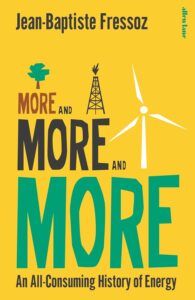
In More and More and More, Jean-Baptiste Fressoz offers one of the most devastating empirical critiques of the idea that modern societies are undergoing a genuine energy transition.
His example is not abstract, but infrastructural, historical, and painfully concrete:
“The perfect symbol of the non-transition is to be found in the heart of the region that is supposed to be its birthplace: between Leeds and Sheffield… the Drax power station.
When it was inaugurated in 1974, this power station was designed to burn coal from the Yorkshire mines. In the 1990s, after it was privatized, Drax imported its fuel from Australia, Russia and South Africa…
The plant was gradually converted to ‘biomass’: a euphemism for wood, which it imports in the form of pellets, mainly from the United States and Canada. Drax claims to produce carbon-free electricity, which is doubly false…
In 2021, Drax burned more than 8 million tonnes of wood pellets—more than the UK’s entire forestry production—to meet around 1.5% of the country’s energy needs… a fine result after two hundred years of energy transitions.” (p. 126)
Drax is one of a million examples illustrating not technological failure, but conceptual failure.
• Energy systems do not “transition” by substitution alone
• New energy sources pile on top of old ones
• Global extraction, transport, and ecological degradation are merely displaced, not reduced
• Efficiency gains are overwhelmed by scale and demand
Degrowth enters this discussion not as material realism: an insistence that ecological limits cannot be negotiated away through accounting tricks, euphemisms, or offset narratives.
If “green growth” still requires transatlantic supply chains, fossil-fuelled machinery, and the liquidation of forests to sustain marginal energy gains, then the problem is not implementation—it is the growth paradigm itself.
Degrowth asks a more difficult but honest question:
What kinds of lives, infrastructures, and economies are compatible with planetary limits and human flourishing everywhere for everyone—without outsourcing the damage?
There is no ‘elsewhere.’
This is not an ideological position. It is an empirical one.